All-Yiddish ‘Fiddler’ Captures How Jews Really Spoke To Each Other

Graphic by Angelie Zaslavsky
By Rukhl Schaechter July 18, 2018
This article originally appeared in the Yiddish Forverts.
As soon as the film version of “Fiddler on the Roof,” based on the stories of the classic Yiddish writer, Sholem Aleichem, came out in movie theaters in 1971, my family and I went to see it. I thought it was wonderful, especially the songs. I learned the lyrics to most of them by heart, including “If I Were a Rich Man,” “Matchmaker Matchmaker” and “Do You Love Me” and even taught myself how to play them on the piano and the guitar.
But I loved it because I loved all good musicals. To me, a young teenager in the Bronx, “Fiddler on the Roof” was another great American musical like “The Sound of Music” and “West Side Story.” But did it feel like a Sholem Aleichem story? Not really. I attended Yiddish schools throughout my childhood and teenage years and read Sholem Aleichem’s stories in the original. This film didn’t seem particularly Yiddish to me.
Nor was it supposed to. Joseph Stein who wrote the book for “Fiddler” and Sheldon Harnick who wrote the lyrics, openly admitted they didn’t want it to be too Jewish because they wanted it to have universal appeal. The theme of a middle-aged man trying desperately to transmit traditions to his four daughters in a rapidly changing world — this was something even audiences in Japan could appreciate. In fact, “Fiddler” did very well in Japan.
But the first time I heard the songs of “Fiddler” translated into Yiddish for an Israeli production, that was a revelation. “Fiddler Afn Dakh” as it was called, had its premiere in Tel Aviv in 1966 but I didn’t hear about it till the 1970s, because the musical never made it to the U.S. Director Giora Godik ran into such severe debt that he abruptly fled Israel. So after the show played for six weeks, that was the end of it.
But at some point someone gave me a cassette of the score. To me that was like listening to Sholem Aleichem set to music. It wasn’t just that the rhymes and the rhythm worked very well; the lyrics actually reflected the true mindset of the Jew in the shtetl. I didn’t know Shraga Friedman but I was amazed at how clever his translations were, how steeped they were in the Yiddish idiom and traditional religious Jewish lifestyle, even though Friedman himself was a secular Jew.
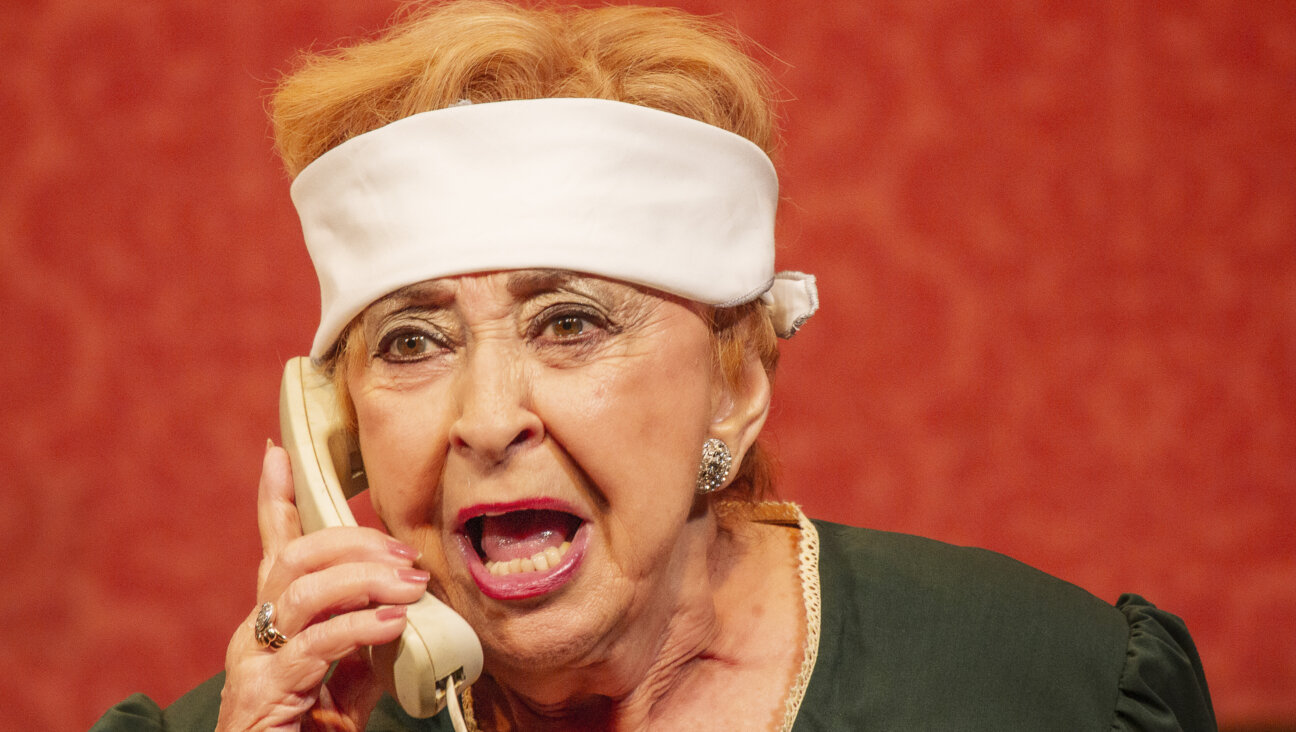
That delight in hearing the extraordinary Yiddish translation of the Israeli “Fiddler” production returned to me as I watched the revival of the Yiddish-language version of “Fiddler” at the Folksbiene. The play sparkles with the authentic Yiddish dialogue you might read in a Sholem Aleichem story, peppered with Biblical quotes and references in loshn-koydesh, the ancient mix of Hebrew and Aramaic used in Torah study. In other words, this was not just a play where the characters spoke Yiddish to each other; it was steeped in Yiddishkeit, the traditional Jewish way of life.
All the lines in the play are accompanied by supertitles in both English and Russian.
In the first scene, a huge banner encompassing the backdrop with the word “Torah” written in the Hebrew alphabet, hints that the leitmotif in this “Fiddler” is not only the tension between holding on to tradition and acculturating to modern society (although this is surely a crucial part of it), but also a specifically Jewish problem that Tevye (played by Steven Skybell) needs to resolve: How will his children remain Jewish without the religious traditions embodied in the Torah?
This theme runs indirectly through the play, as traditional religious expressions color the characters’ conversations. When Tevye’s daughter, Hodl (Stephanie Lynne Mason), tells her father that she and Perchik, a young Jewish revolutionary from Kiev (Daniel Kahn), want to marry but seek only Tevye’s blessing, not his permission, Tevye is enraged. “No!” he bellows, adding: “Loy mit an alef,” a Hebrew-Yiddish word play meaning “absolutely not.”
Later, when Tevye begins to suspect that Perchik may have been arrested, he asks his daughter sardonically, yet not without tenderness: “Is he in trouble, that Samson of yours?” referring to the Israelite judge of superhuman strength described in the Hebrew Bible.
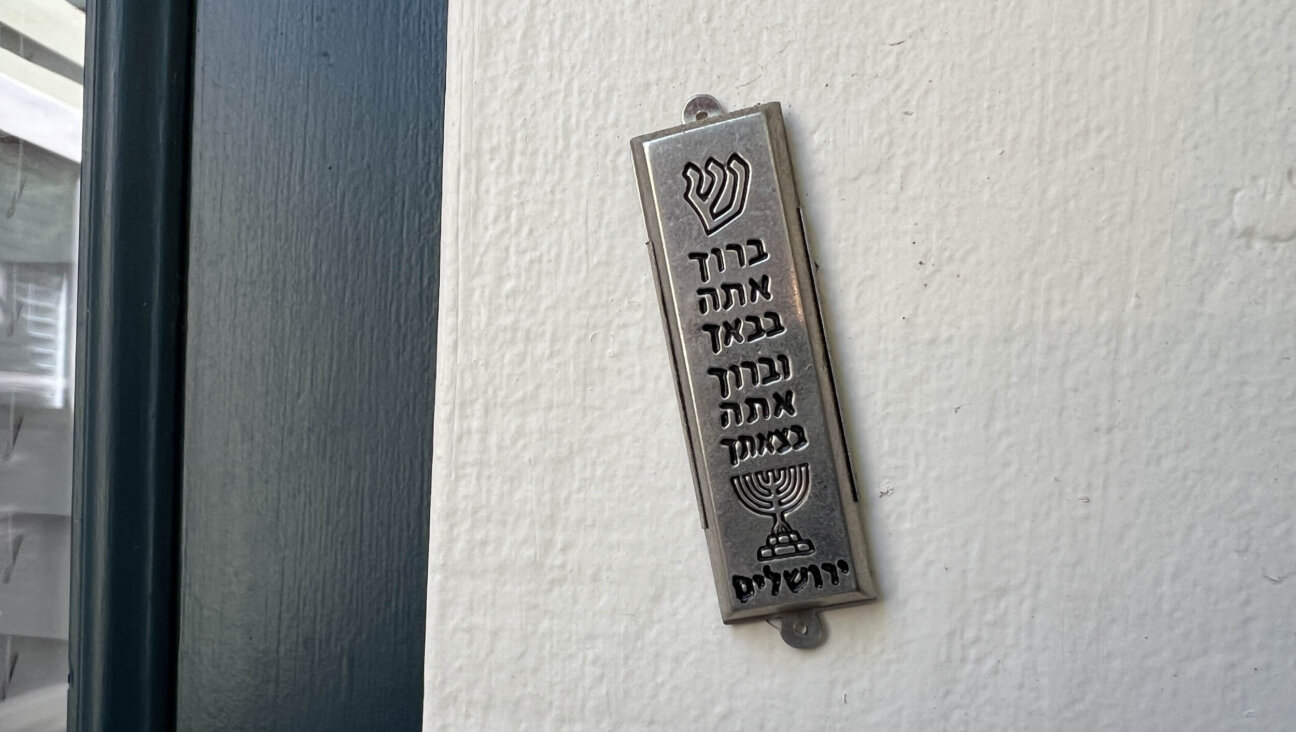
Other traditional elements in the play are a bit more subtle. Every time certain characters appear on the stage, like the matchmaker, Yente (Jackie Hoffman), or Tevye’s son-in-law, Motl (Ben Liebert) — they swiftly kiss their fingers and stretch their hand upwards as if kissing a mezuzah. There are no doors onstage so this motion is, in effect, the only sign given to the audience that the person has just entered the room.
One could argue that a play replete with specifically Jewish terms and references might be lost on a portion of the audience. After all, there’s a limit to how much the supertitles can translate. But it doesn’t really matter. Often, experiencing a moment on stage viscerally is more powerful than fully comprehending it. Whether the person watching a play in Yiddish is knowledgeable about Jewish practice or not, he or she ought to listen to the way Yiddish was spoken for hundreds of years, rich with vivid and witty folk expressions related to to religious and spiritual matters, because without this element, the Yiddish language is little more than an empty vessel.
Hopefully, this will be the first of many plays whose dialogue includes the colorful religious phrases and references that characterize much of the Yiddish tongue. We certainly have plenty of source material in our vast literary tradition to choose from. In fact, maybe we can go back to Sholem Aleichem’s fictional shtetl, Kasrilevke, and bring onto the stage another favorite hero of his: that lively, mischievous schoolboy, Motl, the cantor’s son. Although Motl’s adventures, like the Tevye stories, are fictional, the authentic and colorful expressions that he and his friends and relatives use remind us exactly how Jews used to speak – and argue – with each other. And that in itself makes it a delight to watch.
Why I became the Forward’s editor-in-chief
You are surely a friend of the Forward if you’re reading this. And so it’s with excitement and awe — of all that the Forward is, was, and will be — that I introduce myself to you as the Forward’s newest editor-in-chief.
And what a time to step into the leadership of this storied Jewish institution! For 129 years, the Forward has shaped and told the American Jewish story. I’m stepping in at an intense time for Jews the world over. We urgently need the Forward’s courageous, unflinching journalism — not only as a source of reliable information, but to provide inspiration, healing and hope.
 , editor-in-chief
Support our mission to tell the Jewish story fully and fairly.