Zackary Sholem Berger is a frequent contributor to the Forward and the Yiddish Forward. He lives in Baltimore.
Zackary Sholem Berger is a frequent contributor to the Forward and the Yiddish Forward. He lives in Baltimore.
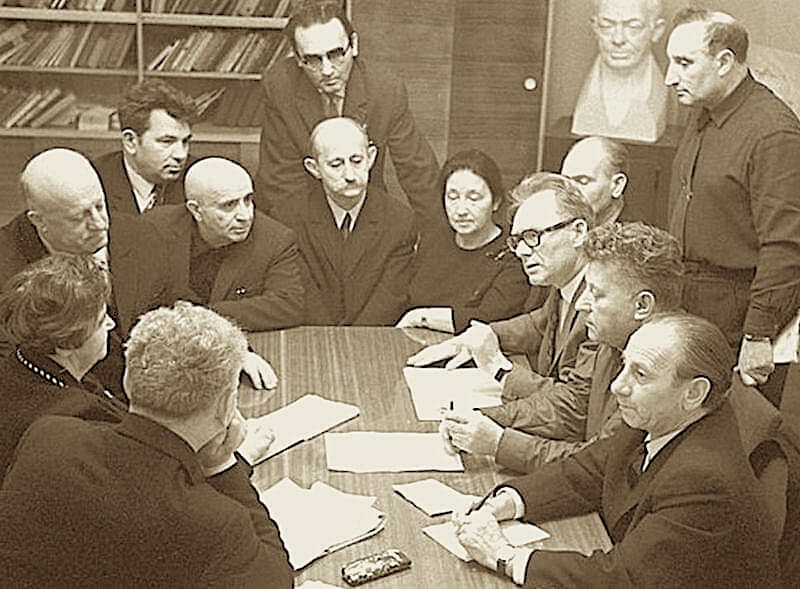
The online issues of "Sovetish Heymland" will be a great resource for scholars and ordinary readers of post-war Yiddish literature

Read this article in Yiddish Qorbanot: Offerings Poems by Alisha Kaplan SUNY Press, 2021 Many people believe that sacrificing for a greater good is a virtue. In the Jewish tradition, even martyrdom in the right context is called “the sanctification of God’s holy name.” But what should you do when holiness is weakened — by…
This article originally appeared in the Yiddish Forverts. Long-time Forward readers know that I work as a primary care doctor, an academic internal medicine physician, at Johns Hopkins Hospital in Baltimore, Maryland. In addition to my other responsibilities, I have been serving quite a different population of patients for the last year and a half….

This article originally appeared in the Yiddish Forverts. In 2005, Internet giant Amazon swallowed up yet another smaller fish, the self-publishing company CreateSpace, which made it possible to market titles in dozens of languages. Last year, in a decision that you would be forgiven for missing, Amazon announced that CreateSpace was merging with another division:…

As I write these words, my 14-year-old daughter is in Israel with her eighth-grade day school class. I don’t know what to think about the trip. Are such trips a good idea for American Jews? Is it something I should welcome for my daughter? How much laundry will she bring back? I don’t have answers…

This article originally appeared in the Yiddish Forverts. On March 24th, together with my 14 year old daughter and 9 year old son, I will be spending Shabbat differently than we normally do, as participants in the March For Our Lives in Washington, DC. As a doctor, researcher, and a Jew, I believe gun control…

This article originally appeared in the Yiddish Forverts. I stood, legs apart and face to the wall, in the Capitol Police Vehicle Maintenance Division. In other words, a garage. And I thought: I want to shake the hand of the person who invented plastic zip ties. They’re probably doing extremely well for themselves. But let’s…
The poet Yisroel Shtern (1894-1942) was reluctant to publish his own work, once writing about the “over-proliferation of books on this planet.” Nonetheless, in a 1929 dictionary of Yiddish writers, Zalmen Reyzen called him “one of the most important young Yiddish poets in Poland today, though for a full appreciation of his poetry… we must…