
Lisa Traiger
By Lisa Traiger
-

Culture Jill Sobule’s Adaptation of ‘Yentl’ Hews Closely to Isaac Bashevis Singer’s Groundbreaking Work
Somehow it seems absolutely right that the woman who wrote and sang the MTV hit “I Kissed a Girl” and “Supermodel” is penning the slightly subversive, excellently wry and humorous music and lyrics for “Yentl.” No, not the “Papa, Can You Hear Me?” “Yentl” that Barbra Streisand boldly made in homage to herself; the upcoming…
-

Culture How ‘Camp David’ Peace Talks Became the Stuff of Drama
Nations don’t make peace, people do. That fundamental rule of foreign policy is at the crux of “Camp David,” Lawrence Wright’s new play about the 1979 Israel-Egypt peace negotiations, which is receiving its world premiere at Washington’s venerable Arena Stage at the Mead Center for American Theater. Wright, the Pulitzer Prize-winning author of “The Looming…
-
The Schmooze Woody Guthrie Gets Onstage Musical Treatment
Woody Guthrie sang of America’s “redwood forests” and “gulf stream waters.” The traveling troubadour and American folk poet electrified a nation with his paeans to America’s indomitable spirit and beauty. Oklahoma-born and Texas-raised, he also ignited mighty debates with songs and writings that took on the establishment and sought to elevate the working masses. His…
-
The Schmooze Inside the Sex Industrial Complex
There won’t be much physical action in “Married Sex,” Washington, D.C.-based playwright Laura Zam’s latest work. And, truthfully, like the complaints of many long-married couples, the sex in this one-woman show is really just a starting point to discuss relationships, traumas and healing. But the play, which makes its New York debut August 10 as…
-
The Schmooze A Playwright Confronts His Shadows
Playwright Ari Roth stumbles sometimes when discussing the characters in “Andy and the Shadows,” his family drama that opens this week at Washington, D.C.’s Theater J. In fact, when Roth discusses Nate, the patriarch in the work, he slips, saying, “my father.” It’s undestandable, for Roth, long-time artistic director of Washington D.C. JCC-based theater, has…
-

Culture Marc Chagall on Parade
A woman swathed in scarlet tulle dangles upside down, like an exhausted circus acrobat, gripping the bars of a swaying steel prism. Alongside her floats a bride — a trapeze artist in flowing white silk. A cow-headed man in a gray suit hangs on as if for dear life. The images recall the work of…
-

Culture Choreographing Across The Continents
Netta Yerushalmy is fascinated with the relationship between how one dances and where one dances. About two and a half years ago, the Israeli-raised, New York-based choreographer embarked on a choreographic process that spanned two continents. Her aim: to explore the how, where and what, when it comes to creating her dances. With the aid…
-
The Schmooze First Israeli To Study in Russian Ballet Academy
When Noa Erlitzki flies to Russia early next month to enroll in the Perm State Choreographic College, the 19-year-old ballerina will become the first Israeli, and among a very few Americans, to study in one of the most venerable ballet academies in the world. Haifa-born Erlitzki was a late bloomer in the ballet world, already…
Explore
Most Popular
- 1

Opinion New York’s Israel Day parade was a shanda — but not because of Mamdani
- 2

Books In ‘Something We Said,’ Richard Pryor’s daughter finds words to discuss the unspeakable
- 3

Opinion It’s time for Jews who love Israel to give up on Zionism
- 4

Opinion Israeli and diaspora Jews live in different realities. The Israel Day parade proved it
In Case You Missed It
-
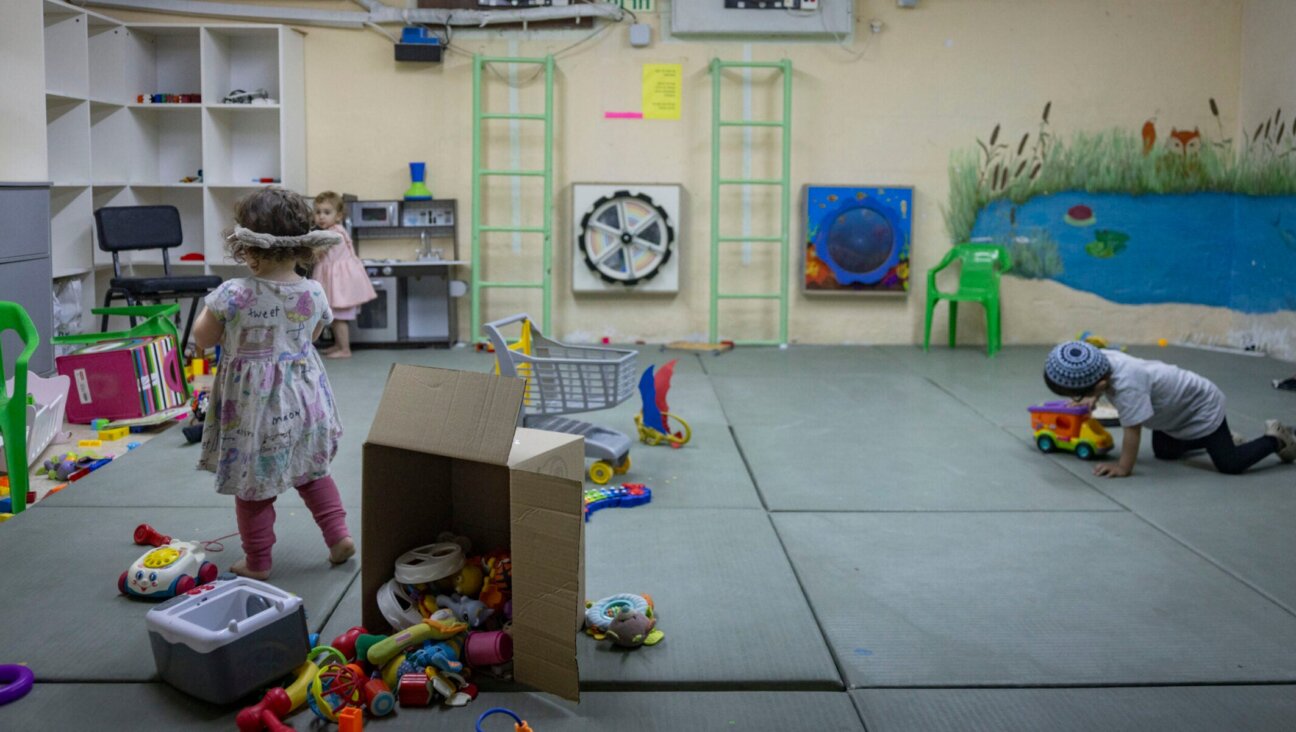
Fast Forward ‘This is sort of their normal’: Israelis confront yet another wartime flare after Iranian fire
-

Fast Forward Celebrated German Jewish bakery closes, saying ‘the hatred reached Berlin’ after Oct. 7
-

Fast Forward Dave Matthews pushes back on claims his criticism of Israel is antisemitic
-

Sports Memes, mashiach and ‘Torah-cyclopedias’ put a Jewish twist on the Knicks’ title chase