
Jerome A. Chanes
By Jerome A. Chanes
-

Culture Revisiting the Jewish Crime of the Century
Compulsion By Meyer Levin Fig Tree Books, 480 pages, $15.95 Why, in 2015, should we be interested in a novel that was written 60 years ago? Moreover, why are we interested in a crime that was committed 90 years ago? When I was growing up in New York in the 1950s, there was no one…
-

Culture Sure, Jesus Was Son of God. But How Was His Fiction?
● Short Stories by Jesus: The Enigmatic Parables of a Controversial Rabbi By Amy-Jill Levine HarperOne, 320 pages, $25.99 When we were children, many of us (especially those of us in yeshivot) were taught to abominate the Christian Scriptures; they were precursors to 2,000 years of Jew hatred. At the very least, it was suggested…
-

Culture Anita Shapira Examines the Rise and Fall of David Ben-Gurion
Ben-Gurion: Father of Modern Israel By Anita Shapira Yale University Press, 288 pages, $25 Another book on David Ben-Gurion? Many are the studies of the iconic Zionist leader — Shabtai Teveth’s massive and comprehensive political biography, “The Burning Ground,” is an analysis from the political center; Ben-Gurion confidant Michael Bar Zohar’s 1968 “Ben Gurion: The…
-

Culture The Only Thing Worth Working For, Worth Fighting For, Worth Dying For
● Palestine in Turmoil: The Struggle for Sovereignty, 1933-1939 By Monty Penkower, Touro College Press, 348 pages, $39 Monty Noam Penkower, in the latest of his fine works on the genesis of the State of Israel, examines in detail the history of 1930s Palestine. But counterintuitively, Penkower’s context for “Palestine in Turmoil: The Struggle for…
-

Opinion Orthodoxy — It’s Not What They Want You To Think
American Apparel’s idea of an Orthodox man What is “Orthodox”? Is it “Haredi”? Is it “Modern”? Is it “Ultra”? Is it “Yeshivish”? These days, the Orthodox world is a confusing place. Fifty years ago, Orthodox Jews (who had been known at the turn of the 20th century as “Traditionalist”) talked about three flavors of Orthodoxy:…
-

Opinion Maharat Graduation Surprised Me — Twice
Last year’s Maharat graduation ceremony / Robert Kalfus Two dramatic moments punctuated yesterday’s graduation ceremony of the New York-based Yeshivat Maharat, the rabbinical academy for Orthodox women, which ordained its second class of women who will serve Orthodox communities as poskot — halakhic decisors and advisors. They were granted the title “Maharat,” and acronym for…
-
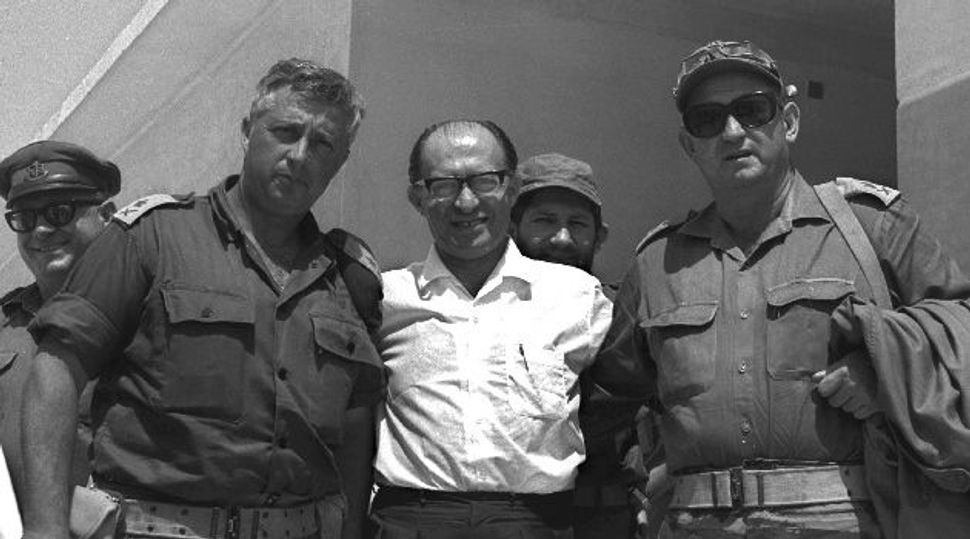
Culture Searching For the Soul of Menachem Begin
Menachem Begin: The Battle for Israel’s Soul By Daniel Gordis Schocken, 320 pages, $27.95. Menachem Begin was one of the more complex personalities in Zionist history. Certainly, he was among the most controversial, and his story has been oft-told. Amos Perlmutter’s 1987 “The Life and Times of Menachem Begin” was conceived as a political biography,…
-
Culture Give Me Liberty or the Tanakh
In God’s Shadow: Politics in the Hebrew Bible. By Michael Walzer Yale University Press, 256 pages, $28.00 In the early 1980s, the late Israeli prime minister Menachem Begin was slugged by many American Jews for what some on the American Jewish center-left perceived as an unsavory embrace of Fundamentalist Christians, who had expressed warm support…
Explore
Most Popular
- 1

Opinion New York’s Israel Day parade was a shanda — but not because of Mamdani
- 2

Books In ‘Something We Said,’ Richard Pryor’s daughter finds words to discuss the unspeakable
- 3

Opinion It’s time for Jews who love Israel to give up on Zionism
- 4

Opinion Israeli and diaspora Jews live in different realities. The Israel Day parade proved it
In Case You Missed It
-

Fast Forward ‘This is sort of their normal’: Israelis confront yet another wartime flare after Iranian fire
-

Fast Forward Celebrated German Jewish bakery closes, saying ‘the hatred reached Berlin’ after Oct. 7
-

Fast Forward Dave Matthews pushes back on claims his criticism of Israel is antisemitic
-

Sports Memes, mashiach and ‘Torah-cyclopedias’ put a Jewish twist on the Knicks’ title chase