Touring the Old World: Ruth Ellen Gruber Explores Eastern Europe
For that quiet expatriate in each of us, Ruth Ellen Gruber is living a European dream. After graduating from Oberlin College in 1971, she went to Europe, spent 10 years as a United Press International correspondent and never returned to live in the United States. Now, with the release of her newly updated “Jewish Heritage Travel: A Guide to Eastern Europe,” published last year by National Geographic, Gruber sat down with the Forward’s Eli Rosenblatt to talk about her book’s maneuver into the shadowed lands of prewar Jewish life, and about tourism after the fall of the Soviet Union.
Eli Rosenblatt: Many of the entries in the guidebook paint a picture of small villages where abandoned synagogues stand; however, in your entry for Cluj, Romania, you note that the Sas Chevre Synagogue, built in 1922, has undergone a threefold transformation to a furniture store from a synagogue, and today, to a Jewish studies institute. Does this sort of transformation signify a trend?
Ruth Ellen Gruber: What do you do with a synagogue that isn’t used, in places where few or no Jews live, is a fundamental question. After World War II, you saw surviving synagogue buildings turned into warehouses, fire stations, offices, museums, cultural centers, churches and more. Others stood in ruins. Though synagogue buildings themselves are not sacred, some uses seem inappropriate. In the mid-1990s, the Sas Chevre Synagogue was closed, stripped of all vestiges of its original identity and rented out to the furniture store to gain income for the Jewish community in Romania. I was happy when the Jewish studies institute at the local university took it over a few years ago.
E.R.: How has Jewish tourism in Europe changed since the fall of the Soviet Union? How did the parting of the Iron Curtain affect your research?
REG: When I researched and wrote the first edition of the book, it was just after the fall of communism. Very little was known [about] what was there, what was left. Under communism, interest in Jewish memory was virtually taboo in much of Eastern Europe. A few people had done documentation work on Jewish sites, but they didn’t have much contact with each other. These people became my guides to the region and its Jewish heritage. At the time, though, as I drove endless miles around these countries, I felt like an explorer, even an archeologist.
So much has changed since the first edition came out [in 1992]. For one thing, most of the countries are in the European Union, NATO or both. Tourism is much easier; there is a totally different atmosphere.
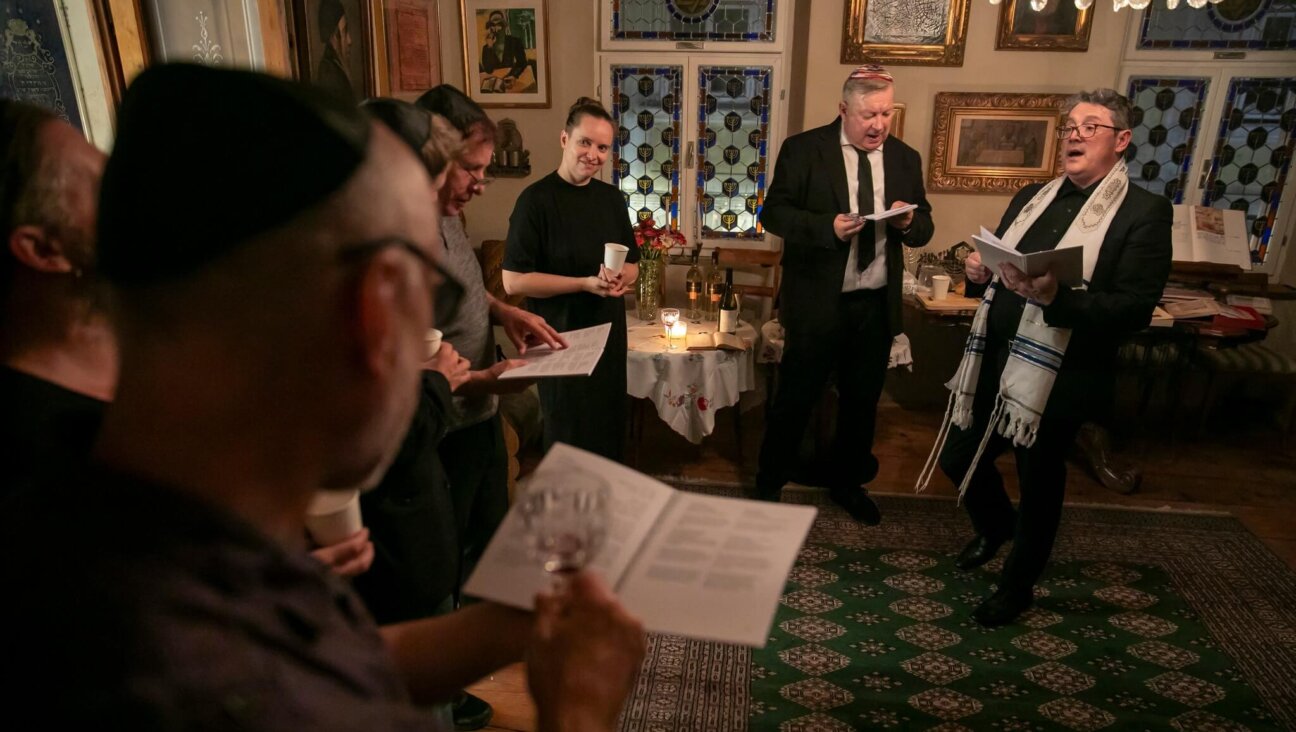
Detailed surveys and inventories of Jewish heritage sites have been carried out in most countries. There have been many efforts to clean up and restore cemeteries and synagogues. Some old Jewish quarters have been restored as town attractions. There are a number of new Jewish museums and exhibitions, some of them located in restored synagogue buildings.
Also important is the fact that there are revived Jewish communities in these countries. Most of these communities are very small. Still, they mean that there is a growing number of kosher restaurants, as well as the possibility of synagogue worship and cultural events.
E.R.: You note in your introduction that “Israel considers some countries in the region to be among its best friends. Be prepared, though, to see anti-Semitic slogans daubed on walls or even gravestones.” Why such a juxtaposition?
REG: Well, if you read the media today, and if you have family that comes from that part of Europe, sometimes all you know is that there is antisemitism there. I wanted to prepare people that, yes, they might see graffiti and other evidence of antisemitism, but also to tell them that’s only part of the story. Visitors should be aware that some of these countries have good, close relations with Israel on many levels. I mention in the book, in a town in Lithuania, I saw a swastika daubed on a wall — and above it, someone had written, in Hebrew, “Am Yisrael Chai.”
E.R.: You spent 2007 on a Guggenheim Fellowship to study the American West in the European imagination. How did you arrive at this topic?
REG: After the September 11 [attacks], I wanted to explore how Europeans look at the United States, and I narrowed that broad topic down to this facet. But in many ways, my interest grows out of the years I have spent investigating how contemporary non-Jews in Europe relate to Jewish culture in countries where few if any Jews live today. I coined the term “virtually Jewish” to describe this. There are major differences, of course, between the “virtually Jewish” phenomenon and the “imaginary Wild West.” One has to do with a real, traumatic issue: coming to terms with the Holocaust and its legacy. The other is the embrace and elaboration of a collective fantasy and its translation into personal experience. But both have to do with identity. Maybe fantasies about the Far West are also a way of dealing with a powerful, if more subtle, traumatic experience: a means, perhaps, of relating to a country whose influence is felt in every corner of the world, and in every sphere of life.

Did you know that only 2% of Forward readers donate to support our nonprofit newsroom? That 2% make it possible for millions to read the Forward without a paywall or subscription — removing any barriers to the full and fair Jewish story.
But while the Forward is free to read, it isn’t free to produce. Big stories — like deep dives into the antisemitism data, political scoops or reporting trips to college campuses — take months of research and fact-checking. All while we keep you informed of what you need to know each day.
— Rachel Fishman Feddersen, Forward Publisher & CEO
Support our mission to tell the Jewish story fully and fairly.