Divine Name
In the opening of the book of Genesis, with which we again begin the annual cycle of Torah readings this week, there are, as most reader have noticed, two different versions of Creation. In the first version, Chapter One’s, God creates the world in six days, all plant life on the fourth and human beings, made by Him “in His own image… male and female He created them,” on the sixth. In the second version, Chapter Two’s, He creates a male human being before there are any plants by breathing “into his nostrils the breath of life,” and then takes a rib from him and creates from it a woman.
There is one other striking difference between these two versions that is more apparent in the Hebrew text of the Bible than in English translations of it — specifically, the name of the Creator-God. In Version 1, He is called elohim, translated in all English Bibles as “God.” In Version 2, He is called y-h-v-h elohim, which most English Bibles translate as “the Lord God.”
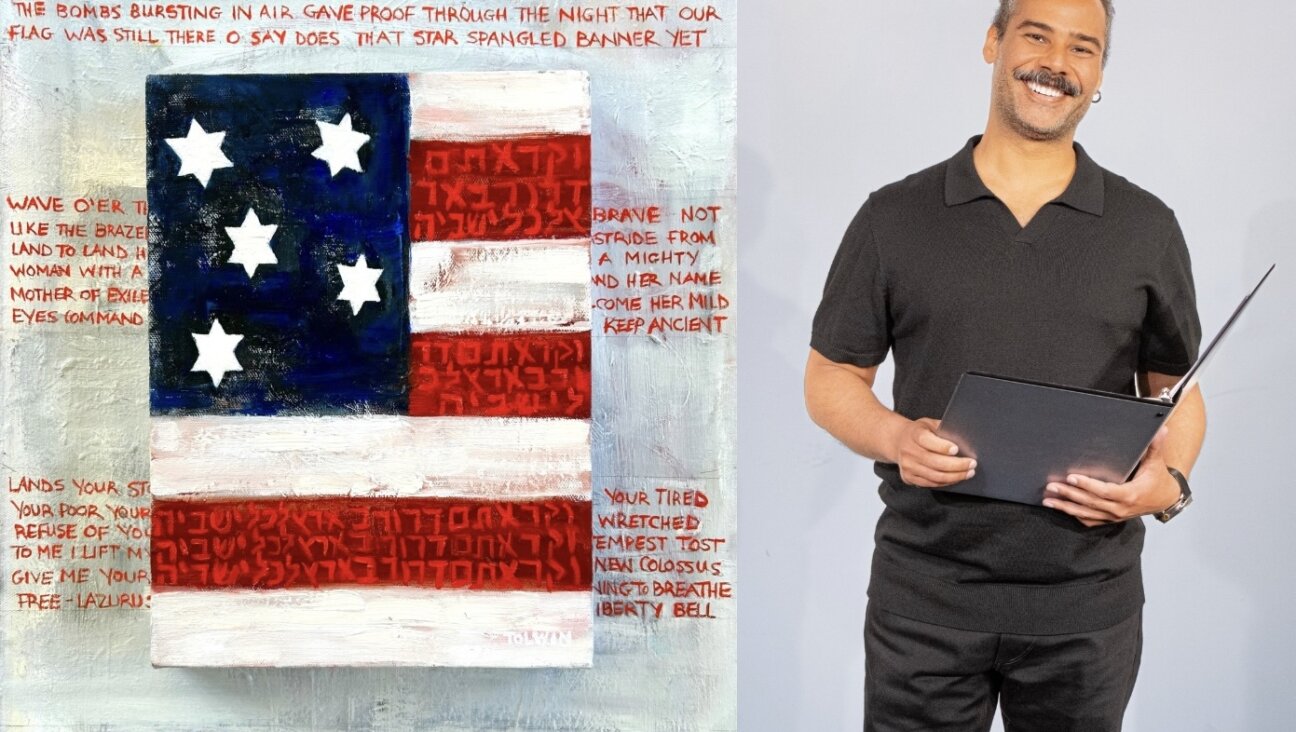
The four Hebrew letters Yod-Heh-Vav-Heh, known in Hebrew as ha-shem ha-meforash, “the explicit name,” and in English as the Tetragrammaton (from Greek tetra, “four,” and gramma, “letter”), have always been a great mystery both to Bible scholars and to ordinary Jews. Scholars have never stopped arguing about how these letters, which, like all words in the Torah scroll, appear without vowel signs, should be or were pronounced. Jews raised in religious homes, on the other hand, are taught never to pronounce them at all but to read them as adonai, “my Lord” (literally, “Lords”) or “Lord.” And they also are taught that adonai, too, is too holy a word to be uttered in ordinary conversation. Therefore, it must be replaced by ha-shem, “the Name,” so that it can be said only during prayer or when reading from the Torah in the synagogue.
Jewish tradition, of course, which regards the Bible as a seamless whole, does not consider the two versions of Creation in Genesis to be in any way contradictory. Version 2 is taken by it to be a kind of close-up, a more detailed description of part of what is described in Version 1 — while as for the matter of plant life, Rashi, the great medieval biblical commentator, explains that though Version 2 also states that plants were created before man, the plants did not begin to grow until afterward.
Biblical scholarship, however, has looked at the matter differently. In fact, the dominant school in modern 19th- and 20th-century biblical criticism, known as Source Criticism, had its intellectual beginnings in the same two versions of Creation in Genesis.
Source Criticism is an approach to the Bible, and especially to its first five books, that holds that it is an edited redaction of different ancient religious traditions — a redaction that is not only not seamless, but one that has poorly concealed stitches that are constantly showing through the biblical text. The most visible and important of these seams, as far as most Source Critics are concerned, is one splicing together two traditions that are known in the trade as E and J, short for “Elohistic” and “Jehovistic.” (“Jehovah” is how the Tetragrammaton was traditionally written in European languages, although many Bible scholars tend to believe that this name, which may be etymologically connected to the Hebrew verb hayah, “to be,” was originally pronounced “Yahweh.”) And the first place where such a splice appears, according to the Source Critics, is in Version 2 of Creation in Genesis, originally a J tradition with a Creator-God named Yahweh that was merged with an E tradition to give us “Yahweh Elohim.”
J and E are not the only traditions identified by Source Criticism. Following the lead of the founder of the school, the German Bible scholar Julius Wellhausen (1844-1918), most Source Critics also speak of P and D, a Priestly tradition that is largely associated with the book of Leviticus, and a “Deuteronomistic” tradition associated with the book of Deuteronomy. By analyzing the Pentateuch as a combination of J, E, P and D, they have sought to explain its many inconsistencies, repetitions, interpolations and abrupt transitions as part of the editorial effort to weave all four of these traditions into a single sacred text.
One does not have to be a believing Jew to question some or all of Source Criticism’s assumptions, such as its belief that if God is called by two different names in two different places in the Bible, we must be dealing with two originally diverse accounts of Him. Some contemporary Bible critics challenge this belief by arguing that just as Jewish tradition regards elohim and the shem ha-meforash as expressions of different aspects of the Divinity rather than of different textual sources, so these two Hebrew names for God can be analyzed in literary rather than historical terms — that is, as choices dictated by their different connotations rather than by a different provenance.
In any case, whether Elohim and Yahweh were originally two different Gods or one and the same, the human beings they created, male and female, were definitely us. The proof is that they made trouble from the moment of their creation and that we’re still making it today.
Questions for Philologos can be sent to [email protected].
I’m personally matching all gifts to the Forward, up to $36,000. Can I match your gift now?

Hello, fellow Forward reader! I’m Joel Brown, a Forward reader and supporter for more than 15 years, and currently the chair of the board of directors.
I’m an avid Forward reader because it ticks so many of my essential boxes: excellent journalism, Jewish focus and diverse viewpoints. In today’s political climate, what I most appreciate is the Forward’s independence — made possible by the generosity of its membership.
The Forward is committed to bringing you unbiased, nuanced Jewish news. From my position as board chair, I see an exciting future as we expand our position as the definitive independent voice of contemporary American Judaism.
— Joel Brown, Forward board chair
Support our mission to tell the Jewish story fully and fairly.