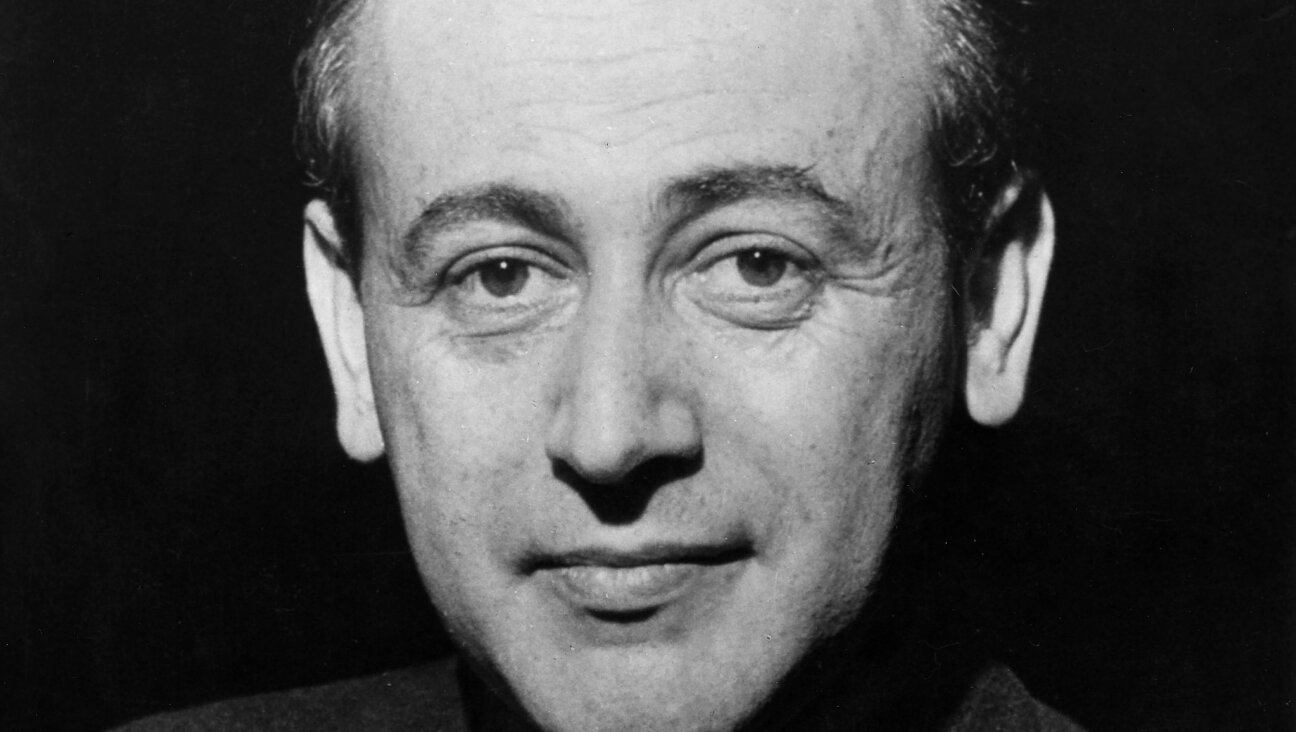
Author and Yiddish scholar David Roskies is out with a memoir that looks at his family’s transmission of Yiddish culture from the Old World of Vilnius to the New World of Montreal and New York. “Yiddishlands” (Wayne State University Press) takes readers on a journey through Eastern Europe, where Roskies’s grandparents owned a printing press and his parents came of age before the emigrating in 1940. According to the author, the book, an excerpt of which was published in the Forward last year, details “the love affair of a mother and her youngest child, and how Yiddish is the glue that holds that romance together.”
In an interview with writer Lana Gersten, Roskies, a professor at the Jewish Theological Seminary and the author of eight books, discusses his memoir and the future of “the language of Jewish secrets.”
Lana Gersten: This book describes Yiddish culture, which was a huge part of the Jewish immigrant experience, as it was transmitted through storytelling and song. Has that oral tradition been lost?
David Roskies: The title of the book is “Yiddishlands,” and the plural is very important, because what it describes are three different settings for the transmission of Yiddish culture. The book begins in the Old World, which was the Yiddish heartland. Because I come from a family of book publishers going back to the 19th century, we look at the culture of the Jewish press; we look at the people and the professional class of my parents’ generation, who were first-generation rebels for whom Yiddish was an expression of the new Jew. In Montreal, it was not a matter of oral culture being transmitted at all. This was a conscious, organized, ideologically driven effort to foster and teach Yiddish. I’m a product of that world. The last part of the book describes Yiddish as a passport to the Jewish world. Yiddish was the language of choice for my parents.
In the chapter Etudes, you talk about the need to make Yiddish young again. Do you think that could ever be accomplished?
Yes. Making Yiddish young again means making Yiddish the language of the Jewish counterculture. And I think that’s still true. It’s true for my students, for whom this is a rebellion against assimilation and self-effacement, trying to pass as something else.
You write that people always told your mother she should write her own memoir, but she never did. What made you want to tell her story?
I began writing the book the day after I got up from shiva, and I spent two years writing that first draft. It was a way of keeping her alive. As long as I was writing the book, I was still in conversation with her. When that draft was over, I could finally let go. All my life, I knew I was writing it. I have all her letters, the 12 hours of tape … I was constantly taking notes when she wasn’t looking.
A lot of children whose parents spoke Yiddish never pick up the language. You were immersed in Yiddish at home. Why was it enticing to you?
Yiddish for me was not an immigrant, second-class culture. To me, this was a world-class culture, and Montreal was only a piece of it that stretched over the globe. Yiddish is the language of Jewish secrets; it is a key to the inner drama of Jewish life. So I learned that first from listening to my mother’s X-rated stories, but that became a metaphor for a much larger intellectual passion.
"To rebel against assimilation" means to reject the society and culture into which the Yiddish speaking Jews have long ago assimilated. Even though this article makes it sound so easy, it should be clear that the American Jews abandoned Yiddish because they wanted to become Americans - it didn't happen by accident. It is hard to believe that there is a Jewish public that wishes to re-adopt an identity that will obviously be outside the mainstream of American life. The return to Yiddish is a very positive ambition. It can indeed revive a Jewish identity that is a "passport to the Jewish world", a Jewish world of clear distinctiveness. It should be noted that the only public that remained loyal to Yiddish is the haredi public, and indeed the Yiddish language is a demonstration of its non-American identity. The most that can be expected of other Jews in America is an interest in Yiddish as a nice hobby. Yiddish as a real language must have a society that is defined by it. To create such a society would necessitate a major educational and ideological movement. It would mean a Yiddish-language day school system and a willingness to return to a Jewish peoplehood identity. It's not going to happen.
I agree with Yehuda. What "Jewish counterculture"? While of course there may be some people who are oriented that way, Professor Roskies needs to learn more about the status of Jews and Judaism in the U.S.
From about 1972 until 2006, the percentage of Americans saying they are Jews decreased from 3.4% to 1.7% (Association of Religion Data Archives). And I recently read (sorry, I can't remember where), that as of this year, the number has reduced further, to 1.2%.
Jews are walking away in droves; they aren't looking for ways to connect to this "counterculture" that the professor speaks of. The "counterculture" is the one saying by their actions that remaining Jewish is counter to their goals!
We need to face this reality and get serious about addressing it. We need a lot more thinking and a lot less grasping at straws for solutions. Above all, we need to understand how attractive secular American identity is and how at present Judaism is just not competing with it very well. Respecting your competitors and your customers is keys to winning competitive marketing battles, which like it or not is what this is.
Many of us are not from Ashkenazi families. I'm not sure what Roskies means when he says that Yiddish should be the language of the Jewish culture, but I hope he does not intend a counterculture that excludes us.
The argument of P. is well known. Because of the very existence of non-yiddish jewish cultures, yiddish culture is felt and described as a kind of intra-imperialistic jewish culture... The only imperialistic jewish culture who fighted and fight today the other jewish cultures, who pretends that there is no place for them and organize the jewish world in such a way : the (ersatz) modern israeli culture. No other jewish culture is learned in "Hebrew" (not "jewish") schools). Some exceptions in Canada, Australia and Mexico but not in the USA and Europe. This culture has no links with the real culture of our families and that's why so many young people feel so alienated from their jewish roots. Some place for Yiddish and yes Dzudezmo or the other jewish languages and cultures and histories would help a lot.
The culture of Israel, Moti, is not fighting other Jewish cultures. I wish it were so. I wish that there would be some competition of Jewish cultures, but sadly there isn't. Dzudezmo? There are no children today for whom this is a native language. Yiddish? Well, it's doing much better than Dzudezmo (Ladino), but only some of the haredim still use it. The only Jewish language that is the language of a whole Jewish society is the Hebrew of Israel. In the Diaspora, Jewish cultural creativity in a Jewish language has come to an end. The Holocaust is one major reason, obviously, but the other major reason is the weakening of Diaspora Jewish identity (assimilation).
How is it possible to speak of weakening-assimilation when speaking about community Jews trained in synagogues, JCC and Hebrew-Jewish schools? Years of Israeli Hebrew teaching around the world and no results, not a book, not a newspaper, nothing! Diaspora languages was dropped out and more than that forbidden and the consequence is : no Hebrew, no Yiddish, no links to the real roots of jewish identity, culture(s) and history. Cultural Policies are also responsable. The competition continues. Until now,jewish schools do not admit (free) Yiddish courses. The opposition is ideological : shlilat hagola. Surely dzudezmo outside maybe Turkey is almost dead but about yiddish : "only some of the haredim"! Hundred of thousands Haredim are speaking yiddish and their number is hugely growing. The little secular yiddish world is also living. Not many people but a vibrant world and many more interesting than the usual Israel-assimilation obsession of the main stream. And the only "Jewish universal language" is English. Give a look (git a kuk) in the Israeli Universities and the Jewish International or European meetings.
It's true, Moti, that years of Hebrew instruction in the Diaspora have led to very poor results. However, the reason for the failure is in the secondary importance given to Jewish education in general. The hours devoted to it are few, and the schools have no standards. It's not just a Hebrew failure, it's a failure of Jewish education in general. Ask a random American Jew to recite the names of the Five Books of Moses or the names of the twelve months of the Hebrew calendar - and you'll find out that the educational failure is in every realm. Moreover, in the Diaspora communities, there is no ideology of "shlilat hagola". Yiddish was abandoned because of the desire to become Americans, not because of a Hebrew-centered ideology. The reason that haredim do speak Yiddish is exactly because they see this language as a tool against the forces of assimilation. Others saw assimilation as the way to social success.
Seeing English as a Jewish language is obviously absurd. English is a common language of academic gatherings, but it carries no Jewish cultural identity. On the contrary - the point of reference of English language symbolisms is entirely outside of the Jewish historic experience. Putting on Israeli Hebrew the burden of "alienation" from Jewish roots in the Diaspora is really silly. The Diaspora communities have the responsibility of educating and challenging their youth. How utterly childish it is to think that others bear the responsibility for your cultural life.
I don't say that others bear the responsability. The ideology of shlilat hagola is absolutely at work in Jewish secular institutions. Diaspora cultures are folklorized if some place is them given. We probably do not speak about the same concerns. The random american Jew is maybe an ignorant but what about students who spend years in Jewish high school... They know a lot about Israel wars and sometimes about "Mikra" (depends on the kind of school) but nothing about the historical paths and the diversity of Jewish experiences - they miss the tools to understand their very place in Jewish history. I do not pretend that English is symbolically speaking a Jewish language but practically it is the tool of communication between Jews. It's not my mother language ((it's obvious), I do not master it but I use it and need it to communicate with Jews of other continents because they do not know anymore Jewish languages.
Moti, your native language is Hebrew, obviously. You belittle the importance of the culture expressed in Israeli Hebrew, but actually it is the continuity of the historic phenomenon of Jewish languages. After all, those who took upon themselves the task of reviving Hebrew were mostly native Yiddish speakers. Hebrew, therefore, continues the role of Eastern European Yiddish: it defines a peoplehood identity. Although I too am a Hebrew speaker, I would still be much happier if the Diaspora communities would have remained loyal to Yiddish or Ladino. Language carries an identity, and that identity has mostly been abandoned for other identities (the only exception is the haredi loyalty to Yiddish). The Hebrew of Israel is essentially today "the only show in town". It is the Jewish language that defines an entire Jewish society.
Motl and not Moti. Do not israelize the entire Jewish world! My native language is french and my second language is yiddish. Yiddish remains in Goles a "show in town" even in his difficult situation. There is a Jewish life outside Israel and the Jewish society of Israel. Roskies issue does not apply to Israel but to Goles. Let us live.
If Yiddish were really significant in today's "goles", then Motl wouldn't be so touchy about Israeli culture. Since Yiddish is so obviously not the the carrier of Jewish cultural life, he seems to believe that the reason for it is the "israelization" of Diaspora Jewish life. Come on. The Diaspora communities don't have a clue about Israeli culture. Most follow the story of Israel as a political issue, not a cultural one. Those who read the literature coming out of Israel read it in translation. One of the many problems of the "goles" is the abandonment of Yiddish as one's primary language. This is not a result of the success of Israeli Hebrew (which the "goles" doesn't know either); rather, this is the result of a change in Jewish identity. Yiddish was a language of Jewish peoplehood. American Jews today, for example, see themselves as part of the American people (hence they adopted American English). Instead of expressing frustration at Israel's culture, wishing it would be out of Motl's sight, it would be much better to view its amazing success as an inspiration. How indeed was Hebrew revived? Perhaps its revival could serve as an example of how Yiddish could be revived as a first language and as a carrier of identity.
Some places in NYC. that teach the yiddish language . thank you rt
As usual, Rosskies is Yiddisher-than-Thou. DR fails to realize that most of our parents knew nothing about the rarefied world of Vilna-style academic Yiddish,and nothing of Yiddish literature and high culture. It was fine with them if Yiddish remained a language to tell secrets in its last generation. Aside from the secular Yiddishists, only the Orthodox cared enough about Yiddish, and that is because their rabbis spoke it.
Today, only the Haredim and Hasidim actually use Yiddish as a language of communication, but YIVO Yiddish it ain't. Gender, tenses, and vocabulary do not exist anymore.
I, too, wish good Yiddish could make a comeback, but it cannot except to hobbyists. It would have been nice if secular Russian, Hungarian, and Israeli immigrants could have helped us, but they mostly are no better at Yiddish than Americans.
Motl, I'm not making any kind of argument -- just informing you that you or Mr. Roskies or Yehuda are not any more Jewish than me. Roskies wants Yiddish to be the language of the "Jewish counterculture". That's not going to work. He is free to start some kind of Ashkenazi counterculture, so he stay with those he is comfortable with; no problem. As for Ladino, I am sure it is a very nice language but it really has nothing more to do with my family or many other Jewish ones than Yiddish does. Finally, as to Hebrew being the only universal Jewish language, this should be quite obvious, as all Jews everywhere in the world have always learned Hebrew as a literary language, just as the Arabs learnt their written language.
The old debates come back... Considering the meanings of Yiddish does not lead to reject Hebrew as the only universal Jewish language. Why do we have to reject a part (Yiddish or remnants of Yiddish) of our legacy, of our lives, of our chilhoods? Why is it so difficult or impossible for the Jewish communities - the JCC, the day-schools, the youth-movements, the camps - to let a place to the Jewish cultures. In my community where almost every Jew is Ashkenazic, nothing is said (I do not speak about "learned") in "Jewish" schools about the cultures of the Jews ; young Jews after 12 years of Jewish day schools do not know that Jewish languages were and sometimes are until today written in Hebrew letters. They do not know that there is a huge Yiddish literature (not entirely disappeared). Is that so dangerous? If we have to follow people here, everything is senseless. Arguments of Hebrew defenders are very closed to arguments of fervent assimilationists...
The Forward welcomes reader comments in order to promote thoughtful discussion on issues of importance to the Jewish community. In the interest of maintaining a civil forum, the Forward requires that all commenters be appropriately respectful toward our writers, other commenters and the subjects of the articles. Vigorous debate and reasoned critique are welcome; name-calling and personal invective are not. While we generally do not seek to edit or actively moderate comments, the Forward reserves the right to remove comments for any reason.