Passover, now a week away, occupies a unique place in the hearts of American Jews. It’s the holiday that most poignantly combines the warmth of family, the pageantry of tradition and the power of Judaism’s universal message of human dignity. More than that, it’s the holiday that most affirms our sense of place and belonging in this society. Passover reminds us that the core values of Judaism and of America are one and the same, beginning with freedom. The holiday’s very symbols are the stuff of American myth. The flight from slavery. The parting of the Red Sea. “Go Down, Moses.” In this season, more than any other time of year, we are aware that to be Jewish is to be American.
This year, alas, it’s a bit harder than usual to summon up that sense of secure belonging. This past week, as the traditional month of Nisan began, signaling the countdown to Passover, we found ourselves bombarded with a barrage — unprecedented in recent memory — of high-visibility media attacks by critics questioning the very place of Jewish activism and advocacy in this country. And not just any critics: The Economist, the world’s most soberly thoughtful newsweekly, in a commentary provocatively titled “Taming Leviathan.” Two-time Pulitzer Prize-winner Nicholas Kristof, leading columnist of the nation’s most respected newspaper, the man whose devotion to human rights put Darfur on the map. George Soros, the iconic liberal philanthropist, a Holocaust survivor who spent hundreds of millions of his own dollars in the past two decades rebuilding civil society in post-communist Eastern Europe.
Their critiques differ in many particulars, but their underlying message is the same. It is, first, that America’s relationship with the Middle East and the Muslim world is catastrophically damaged. Second, that no thaw in that relationship is conceivable without a credible effort to defuse the Israeli-Palestinian conflict, easily the most charged issue on the Arab street. Third, that honest discussion of America’s options in the Middle East is stifled by the heavy-handed actions of Israel’s overzealous defenders in this country. Fourth, that these heavy-handed lobbyists are not representative of the broad majority of American Jews, but that most Jews inexplicably remain silent and allow the hawks to speak in their name. And that it’s time for the silent Jewish middle to speak up.
The response from Israel’s most zealous advocates was swift, and telling. The staunchly pro-Israel New York Sun argued, in an editorial, that Soros and Kristof were peddling a new version of the blood libel, the monstrous medieval myth that Jews murdered Christian children during Passover and baked their blood into matzo. The editor of The New Republic, in a brief entry on his Web log, resurrected his charge from a month ago, during a different spat, that Soros had been a Nazi collaborator (he called him a “cog in the Hitlerite wheel”) in wartime Hungary, a reference to the 13-year-old Soros’s riding along with a Nazi unit as it inventoried Jewish property.
The defenders may have intended to discredit the critics, but they only ended up proving the critics’ point: that Israel’s strongest advocates tend toward bluster and intimidation in place of honest debate.
Not all the defenders were so ham-fisted. David Harris, the soft-spoken executive director of the American Jewish Committee, showed the dignified side of pro-Israel advocacy in a Jerusalem Post essay replying to Kristof. Without stooping to mudslinging, Harris dissected the columnist’s claims that America and Israel are missing opportunities for peace. His point was that the opportunities are illusory, that Israel can only stand firm until a credible partner emerges.
And yet Harris, too, inadvertently bolstered his opponents’ claims. Kristof had argued at length that debate over Israel’s options is far more robust in Israel than it is here. Harris may think Israel has no credible partners for dialogue, but an awful lot of Israelis disagree. They include centrist politicians, Cabinet ministers, top security figures and, not incidentally, a clear majority of the Israeli population. There is nothing blind or naïve in arguing that Israel has other options. It’s simply an accurate reading of Israel’s security debate. Honorable people may take either side.
The question is, what prevents the other side from being heard in this country?
In a sense, there’s something absurd about the question. The debate is raging here, and has been for years. The critiques of Soros, Kristof and countless others published in recent years — in minor and major media outlets, on radio, in public lecture halls — are proof of that. Free speech still reigns.
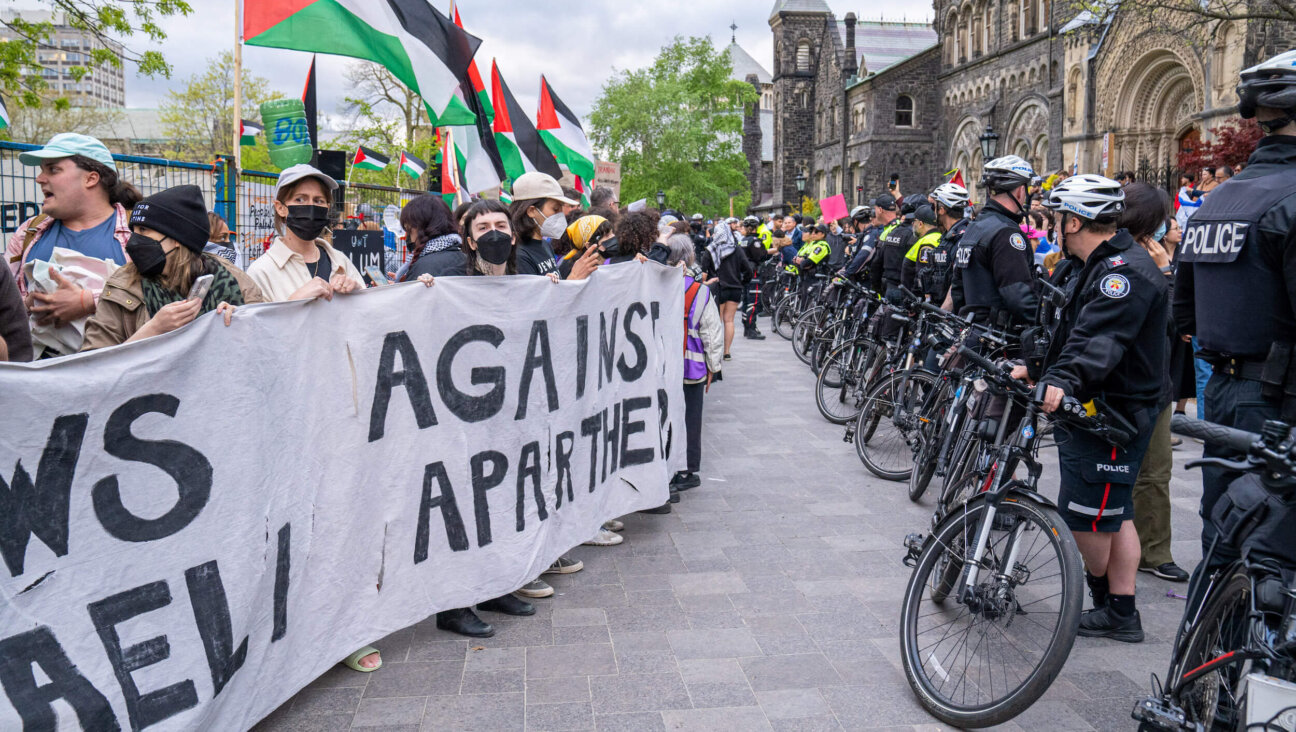
It’s also true that reasonable critiques of Israeli policy aren’t heard as much as the critics would like because they’re overshadowed by unreasonable critiques. From the anti-war movement to the alternative media to the halls of academia comes a steady drumbeat attacking not just Israel’s policies but its very legitimacy. To an alarming degree, the attacks spill over into the rankest antisemitism. And when reasonable critics like Soros or Kristof weigh in with arguments for a pro-Israel alternative, the Internet lights up with applause from the anti-Israel left, delighted that one of “them” finally sees the light.
No wonder reasonable Jewish critics of Israel fear to speak. They don’t want to feed the flames of hate. And who can blame them? Soros himself, in this week’s essay, admits that this fear deterred him for years from speaking on Israel..
But the real complaint of the critics is not that they aren’t heard. It is, rather, that their critiques aren’t translated into policy. Alarmed at the deteriorating fabric of international relations, they identify what seem obvious solutions, yet policy-makers march in the opposite direction. The critics search frantically for some explanation, and they find it in the activities of pro-Israel lobbyists, who block sensible ideas from reaching the chambers of government.
What they forget is that the pro-Israel lobbyists are only doing what they’ve been doing for decades, and yet the dramatic deterioration on the world scene is only six or seven years old. It is the explosive emergence of violent religious extremism as a dominant force in the Muslim world, coupled with the wrong-headed, triumphalist response of the Bush administration, that created this toxic stew threatening to engulf us.
Yes, Israel’s policies helped in some measure — though not as much as its enemies insist — in feeding the despair and anger spreading on the Muslim street. Yes, years of permissive American policy toward Israel’s settlements — abetted in some measure by pro-Israel lobbying — helped plant seeds of frustration on the other side.
But none of that prevented at least five administrations — Ford, Carter, Reagan, Bush Sr. and Clinton — from keeping the dialogue going and nudging the parties patiently forward. It wasn’t until the fall and winter of 2000 and 2001 — with the fateful coincidence of the al Aqsa Intifada, the Bush presidency and the September 11 attacks — that hope began to die and the flames began to rage out of control.
Even after that, Israelis and their foes continued seeking a way out. Israel moved, clumsily, belatedly but genuinely, to embrace Palestinian statehood as a clearly stated goal. The Arab world, led by Saudi Arabia, offered full recognition of Israel as part of its stated end game. What was missing was an American president who was willing and able, like his predecessors, to step in and bridge the sides.
What’s to be done, then? Are we merely hostages to the madness of this side or the recklessness of the other? Passover reminds us that we are not hostages but free people, and freedom means the power and duty to choose. The Exodus was not merely a flight from bondage but a journey to Sinai, with its straightforward pledge to a life of honor and justice. In that sense, Soros and his allies are right: Jews have choices to make. We are commanded to choose life.
The Forward welcomes reader comments in order to promote thoughtful discussion on issues of importance to the Jewish community. In the interest of maintaining a civil forum, the Forward requires that all commenters be appropriately respectful toward our writers, other commenters and the subjects of the articles. Vigorous debate and reasoned critique are welcome; name-calling and personal invective are not. While we generally do not seek to edit or actively moderate comments, the Forward reserves the right to remove comments for any reason.
To post a comment, click to login:
The notion that the vocal voices and chattering classes of the anti Israel and anti American left are somehow intimidated is without merit. As Professor Rosenfeld aptly pointed out, the right to speak and publish articles critical of Israel has degenerated into the anti Semitism of the Left and fantasies that Hamas is a legitimate peace partner. Articles condemning the creation of Israel or suggesting that it is apartheid cannot be considered legitimate criticism in any way, shape or form.
Friends, This is one that we all should read.
Leon, what do you mean that "this is one that we all should read"? I indeed read the article and I noticed that the the point of view of the editorial staff is "that to be Jewish is to be American". I would like to read an analysis of Jewish topics by people who have a Jewish point of view. A line such as an "honest discussion of America’s options in the Middle East" in the third paragraph might appear in an American newspaper, analyzing the issues of Israel from an American perspective. I read the Forward hoping to read an honest discussion of Jewish options.
Well said Reuven. I will only add that the Forward has been hijiacked by a neo-leftist cabal of assimilationists.
I couldn't imagine that the Yiddish edition of Forward would write an editorial claiming that "we are aware that to be Jewish is to be American". The Yiddish language defines a Jewish self-awareness that stands in its own right. Every group of people that speaks its own language has its own distinct cultural expressiveness. I suppose the price of abandoning Yiddish and the adoption of American English has been this very change in essence: The editorial staff of a Jewish newspaper can define Jewish identity as just another expression of the American identity. For centuries and centuries, the Jews were a people among the peoples of the world. The Forward now claims that this historic reality is over. Let's hope that its reading public sees its own Jewish identity as a distinctive phenomenon in the history of mankind.
As a great-granddaughter of one of the founders of The Forward (Avraham Schonberg), I appreciate the coverage given to this issue. As a member of AIPAC, I must say that as a liberal, I am constantly surprised by people who do not understand that AIPAC is non-partisan and who think there is no debate in the U.S. about Israel. Both are misconceptions. And I agree with Ms. Janus.
Can you tell me where you get the information that most Israelis agree there is a peace partner? Is Hamas the peace partner?
While I might quibble with a word here and there, this is one of the most honorable, thoughtful, and humane attempts I've ever seen to wrestle honestly with what's going on in America and the Middle East right now. Thank you.
In the first paragraph of this editorial we read that in "this season, more than any other time of year, we are aware that to be Jewish is to be American". Is the position of the Forward that Jewish identity is part of the American experience? Are Jews who are not living in America part of another peoplehood? After a history of thousands of years in which the Jews everywhere maintained a distinct identity, I am amazed to learn that for the Forward, Pesah is "the holiday that most affirms our sense of place and belonging in this [the American] society" - and not the holiday that affirms our sense of belonging to an historic Jewish peoplehood together with all Jews. What a failure.
Yes, I am proud to be an American a Jew and pro-Israel. I am also thankful to be living in this country where the media is not as anti-Semitic as it is in Europe especially in England. Menalie Phillips has recently described the kinds of anti-Jewish and not just anti-Israel material being broadcasted by the BBC as the well as the Guardian. One Guardian reader taking his or her cure from the paper posted the following: "Jews in the UK are not normal people, they are Anglo-Jewish, and their loyalty to the UK is in question. No matter how many generations or centuries they have been in England, they are still outsiders." From: http://www.melaniephillips.com/diary/?p=1479 Her article begins thus: "The war within the west "An item on BBC Radio Four’s Today programme this morning, along with a back-up article in this week’s Spectator, provides a snapshot of Britain’s moral sickness. Presenter Ed Stourton was trailing a programme he has made, to be broadcast next month, on last summer’s Lebanon war. In the article, he repeats two misleading canards about that war:" Why the Forward would link articles to the antisemitic Guardian is beyond me. Could it be that leftist Jews these days can't tell the difference between honest critcism and antisemitic diatribes? My parents who read the Fervertz in Yiddish are probably rolling in their graves.
Thank you for parsing through the sharp divisions in the simmering and emotional dispute about the role of the "Israeli Lobby" as no other journalist, columnist or blogger has done. This editorial is a true credit to the Forward and to its glorious legacy.
Israelies can enjoy the luxury of a free debate because they and they alohey and they alone pay for the decisions they make For those outside of Israel honest free debate can only take place when the great human quality of empathy is justly dispensed.
The Haggada for Pesah was a creation of the sages in the wake of the destruction of the Second Temple, and the redemption from Egypt was seen as an prelude to the ultimate redemption - hence the seder ends with the call of "next year in Jerusalem". Seeing the holiday's symbols as the "the stuff of American myth" is an indication that someone in the Forward has lost contact with a culture whose point of reference is entirely outside of American history and geography. The Jews saw their early history as an enslaved nation - not as slave owners.
Goldberg is bull[word deleted]ting when he says that Martin Peretz accused George Soros of being a Nazi collaborator. I read the article to which Goldberg is referring, and Peretz said no such thing. Peretz's article was an insightful piece that took Soros - a Holocaust survivor - to task for claiming that George Bush was making America into a Nazi state. Peretz noted that this comparison has not been condemned much in the liberal discourse, and he examined Soros' cynical use of it by citing a 60 Minutes interview in which Soros said he has absolutely no conflicting feelings about helping Nazis confiscate Jewish property, while comparing that awful task to "financial market" philosophy...something that even the 60 Minutes interviewer pressed Soros on and found very odd and somewhat peculiar. Marty's article, while angry, was a window into a the mind of a very odd individual, who, from a billionare bully pulpit, has taken it upon himself to attack Israel and its supporters. It was a critical piece of writing, full of the same probing and doubt that characterizes any good journalism and that the Forward claims it aspires to.
We in Israel are concerned by the often inaccurate, exaggerated media attacks from around the world, but we are also embarrassed by the frequent blind support granted by America, from both Jews and right wing Christian Israel supporters, to the extreme right in Israel. Sober, reasonable policy decisions in Israel are impeded by that unreasoned support, and expansionist, xenophobic policies are encouraged. We have a very vital and vocal democracy, so the damage is not irreparable and the debates continue, but a more sober and disinterested American friend might just encourage a more courageous Israeli stand in the peace process. I’m visiting family in the States right now, and I often find myself in the role of devil’s advocate whenever conversation turns to issues of state, which in fact occurs much too infrequently. Avraham Hanadari Hod Hasharon
Couple of points. First Soros: he himself said that his father had arranged for a change of identity for him and that he was present when an official was inventorying looted Jewish property. What are the chances that a thirteen year old Jewish boy in hiding would be present when a fascist government official was doing such dastardly work? His comments certainly don't suggest a family that was in fear of their lives as were other Jews at the time fearful of theirs. Second, let's face it, who do you think would win an election in a Jewish district, a Soros or a Lieberman? The left has always thought that because they think themselves to be more moral than their opponents that most people also think that way. In fact the left, and here the Forward is no exception, has for generations created fictions like that of "false consciousness" to justify their self righteous beliefs. Then there is the hypocrisy that their critique of Israel is mounted in the name of Judaism. This from a paper which in the same issue has articles criticizing the very idea of remembering the Holocaust and a positive spin on an attempt by a “Jewish” writer to update the Haggadah since obviously the traditional Jewish text is, well, too Jewish. It is certainly too Zionist for the likes of the Forward editorial board. So what we have here is the typical trajectory of anti-Zionist thought: first attack the idea of a Jewish State, then attack the idea of Holocaust commemoration and finally attack the traditional Passover Haggadah since it encapsulates the twin notions that leftist “Jews” hate most: Jewish sovereignty and Jewish memory. These are the roots from which Jewish freedom can flourish.
I'd love to know who these "awful lot of Israelis" are who disagree that Israel has no credible partners for dialogue. Seems that I've read and heard quite the opposite - that most Israelis have grown very discouraged about the intentions of the Palestinians since the Intifada and now again after last summer. While there may be some moderate Palestinians out there somewhere who might actually talk a good story in negotiations, they are in NO position to act for the Palestinian people. Do you actually think they could have any influence on those who fire Qassams or recruit suicide bombers? Not even close! Also, in a couple of instances you suggest that Israel has missed opportunities and has even ignored opportunities and/or other "obvious solutions" for peace! REALLY??? How easy it is to cast around aspersions like this to put Israel in a bad light! OK smarty! Let's hear about some of these "obvious solutions", and be specific, including how the terrorists are to be disarmed and pacified, not to include the nonstarter "right of return"!!!! And if these solutions are so "obvious", why haven't they already been tried?
One principal lesson I draw from this editorial concerns the direct relationship between good faith disagreement about Israeli policy in this country, and how such critiques are often exploited and overtaken by those who despise Israel's very existence and/or those who truly do harbor anti-Jewish feelings. How many times in the last 30 years, and perhaps more, have I heard certain critics of Israel state something like: "Finally, someone has had the courage to take on the powerful supporters of Israel, etc., etc." It is a recurring and tiresome theme; there is indeed no concerted effort on the part of most allies of Israel in this country to stifle debate or legitimate criticism of Israel. I find the frequent and related charge that Jews or supporters of Israel seek to exploit the Holocaust or make reckless charges of anti-semitism to stifle debate to be particularly disconcerting, and again tiresome. Such conduct is unfortunate because this ardent Zionist believes that Americans, Jews and non-Jews alike, have every right to question in good faith this or that policy of the State of Israel. At the very least, American taxpayers are interested parties in the turmoil that is the Middle East. I must say that I do not understand some of the criticism directed at this editorial that appears to focus on the assertion in the editorial that freedom is a core value of both the United States and Judaism. Perhaps I am missing something?
Bruce - The last line of the first paragraph claims that, in this season, "to be Jewish is to be American". Surely, the absurdity of the statement is obvious. I know many, many Jews (actually the majority of Jews in this world) who have never thought for a moment that their Jewishness in this season or in any other season meant that they are American.
Ben: Thanks for pointing that out and I would agree that its fair to call that an overstatement.
Before buying generic [word deleted] read this. I've got new info about generic [word deleted] and share with you.